
If you spend time in RV, overlanding, emergency-prep, or remote-work circles, you’ve probably seen the buzz: the Starlink Mini might soon ship with a battery built right into the dish — no external power bank required. The rumor isn’t coming from nowhere. It started with real code found inside Starlink’s own firmware, and it was picked up by outlets including The Verge, PCMag, and Digital Trends.
So before you assume the days of carrying a power station are over, let’s separate the verified evidence from the speculation — and look at what a battery-integrated Mini would (and wouldn’t) change for anyone running off-grid.
What was actually found
The trail begins with firmware analysis, not a marketing leak. Jinwei Zhao, a PhD researcher at the University of Victoria who routinely studies Starlink firmware, spotted new strings in a build dated May 7, 2026. Two clues stand out.
Ravion® · Built only for Starlink Mini
Run your Mini up to 9 hours, no outlet.
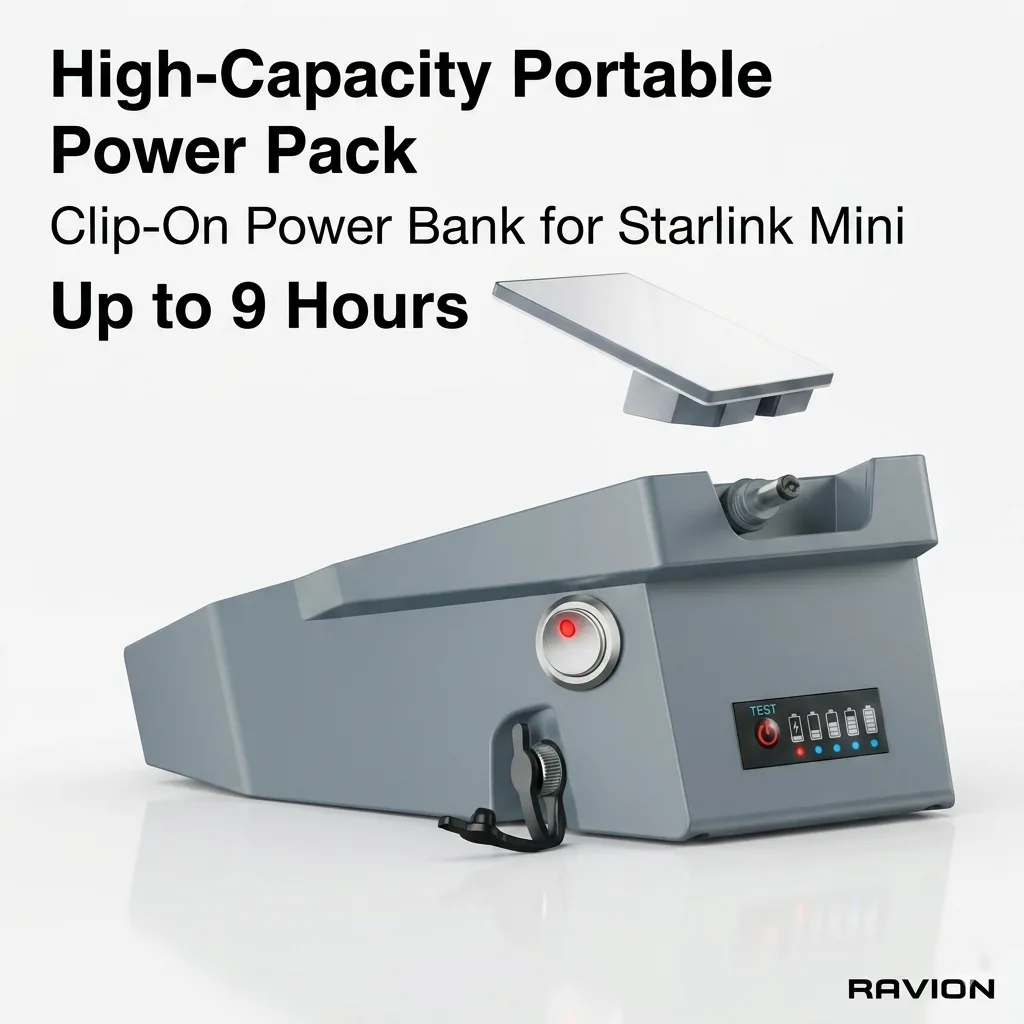
Ravion® Battery
158Wh · up to 9 h runtime · IP65 · 2.6 lbs · Under FAA 160Wh limit
$328 Shop now →
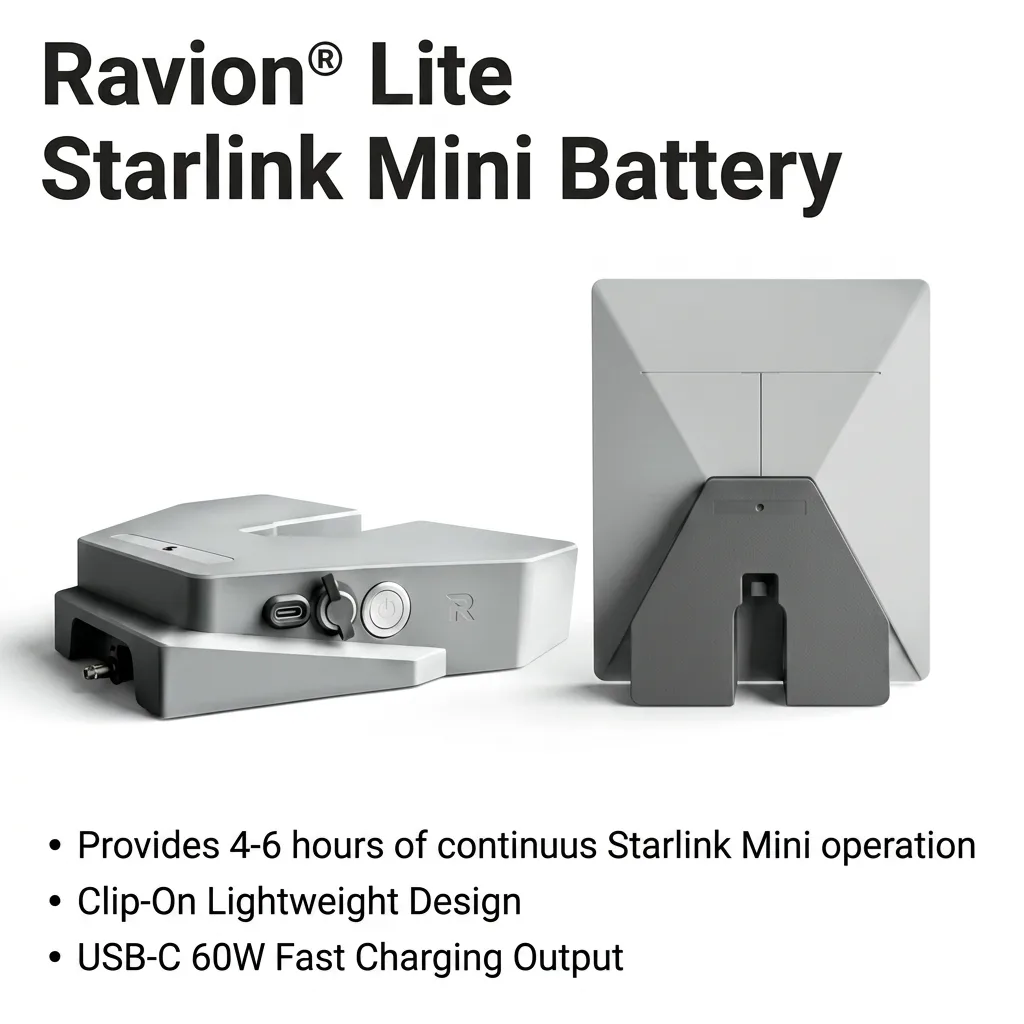
Ravion® Battery Lite
99Wh · up to 6 h runtime · 1.9 lbs · USB-C 60W out
$189 Shop now →
Free U.S. shipping · 30-day returns · 12-month warranty · Ships from California in 1 business day · See all power kits
The smoking-gun strings
Three explicitly defined power-source states:
PowerSource_USBC
PowerSource_BATTERY
PowerSource_USBC_AND_BATTERY // run on wall power, internal battery, or bothPlus a battery-monitoring message:
message DishBatteryStats // state of charge, charging status, active power sourceWhy does this matter? A DishBatteryStats field is built to report the device’s own charge level — something the dish simply can’t do if it’s just plugged into a generic third-party power bank. The hardware reading its own battery percentage is the tell that a power source is meant to live inside the unit.
A second, corroborating leak
Independently, Ukrainian Starlink repair technician Oleg Kutkov flagged a device labeled MINI1_RUGGED_PROD1 in a separate firmware build — a ruggedized terminal that observers suspect is aimed at industrial, field, or military use, exactly the scenarios where a built-in battery earns its keep. You can read the technical breakdown here.
The important caveat: This is code pointing at hardware that doesn’t exist yet. No current Starlink Mini has an integrated battery, and SpaceX has not officially announced any new model. Firmware references sometimes ship months later — and sometimes never ship at all.
Does this “kill” the portable Starlink battery?
Short answer: no — and here’s the reasoning that matters for anyone who actually relies on a Mini off-grid.
Any battery integrated into a dish has to fit a portable form factor, which means it will be sized for convenience and short untethered bursts — closer to the battery in a phone than the capacity in a dedicated power station. The Mini draws meaningful power in the field (commonly cited in the 20–40W range, and lower at idle after recent firmware efficiency gains). A small internal cell competes with “grab it and walk 50 feet” — not with running a connection through a full work day, an overnight camp, or a multi-day outage.
What a built-in battery helps
- Faster setup — fewer cables to fish out of a bag
- Brief moves and repositioning without losing the link
- A cleaner, more “appliance-like” product for casual buyers
What still needs real external power
- All-day remote work and video calls
- Overnight and multi-day off-grid camps
- Emergency preparedness & outage resilience
- Vehicle / RV installs that run for hours
In other words, a more portable Mini doesn’t shrink the off-grid market — it grows the number of people taking a Mini into exactly the situations where extended runtime is the whole point. The need shifts from “keep it on at all” to “keep it on for as long as the trip demands,” and that’s precisely where a high-capacity pack earns its place.
What to do right now
Nothing about an unannounced model changes the math for the Mini you own today. If you’re running one in the field, the priorities are the same: a clean, properly-rated power feed and enough watt-hours to outlast your use case. Our Ravion® power systems and field batteries are built around the Mini’s real-world draw, and our runtime & setup guides walk through sizing a battery to the hours you actually need.
 Ravion® for Starlink Mini — certified flight-ready · 6–9h continuous operation · Shop now ›
Keep your Mini online — for hours, not minutes
Whatever SpaceX ships next, real off-grid runtime comes down to watt-hours. Power your Starlink Mini with a kit engineered for it.
Shop Ravion® Power KitsFrequently asked questions
Is the battery-powered Starlink Mini confirmed? +
Where did the rumor come from? +
Would a built-in battery replace my external power bank? +
How much power does the Starlink Mini actually use? +
Should I wait to buy a power solution until the new Mini launches? +
Sources & further reading
- Digital Trends — Starlink Mini may finally cut the cord with a battery-powered dish
- RouterArena — Starlink Mini firmware reveals plans for built-in battery and USB-C
- Mezha — Starlink firmware mentions a new rugged Mini with battery and USB-C
Original reporting credited to The Verge and PCMag.
Editorial note: This article reports on unreleased firmware findings and community analysis. As of publication, SpaceX has not officially announced a battery-integrated Starlink Mini, and no specifications, pricing, or release timing have been confirmed. Details may change. Starlink® and Starlink Mini are trademarks of Space Exploration Technologies Corp.; Satellite Link Power is an independent accessory provider and is not affiliated with or endorsed by SpaceX.