How Long Does the Starlink Mini Run on Battery?
Everything that decides your off-grid runtime — real power draw, the math, a runtime chart, and an honest comparison of every battery built for the Starlink Mini in 2026.

The Short Answer
A Starlink Mini draws roughly 15W idle and 20–40W in active use. On a compact 99Wh clip-on battery that means about 4–6 hours of connectivity; on a 158Wh pack you'll get about 6–9 hours; and a 250–300Wh portable power station stretches that to roughly 8–15 hours. Add solar or pass-through charging and you can stay online indefinitely.
If you're taking the Starlink Mini camping, into an RV, onto a boat, or into the field, one number rules everything: how long it stays online without an outlet. The good news is that runtime is easy to estimate once you know two things — how much power the dish actually pulls, and how much energy your battery holds. This guide walks through both, then ranks the real-world battery options so you can match the right pack to your mission.
How Much Power Does the Starlink Mini Actually Use?
According to Starlink's official power specifications, the Mini averages 20–40 watts in active use and drops to about 15 watts when idle. That's less than a third of what a full-size Standard dish consumes, which is exactly why the Mini has become the go-to terminal for portable, battery-powered setups.
Ravion® · Built only for Starlink Mini
Run your Mini up to 9 hours, no outlet.
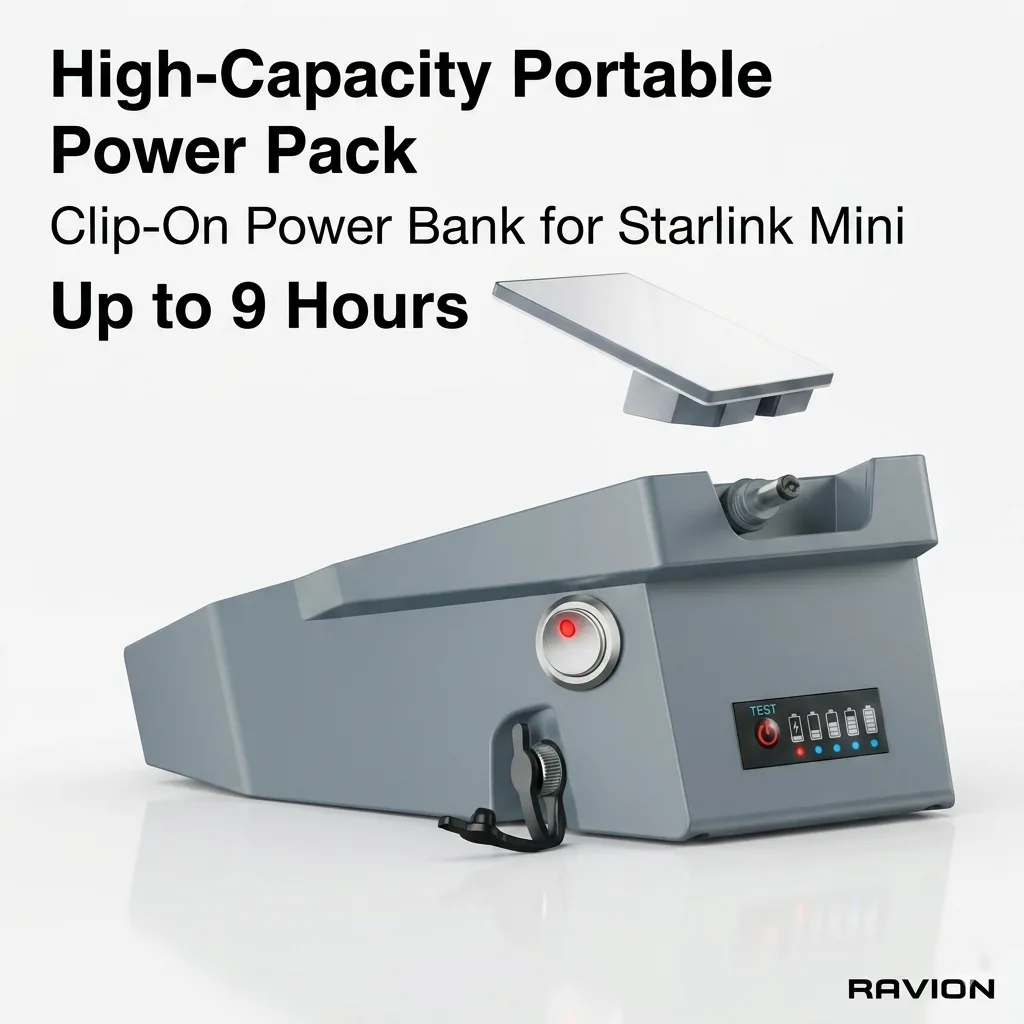
Ravion® Battery
158Wh · up to 9 h runtime · IP65 · 2.6 lbs · Under FAA 160Wh limit
$328 Shop now →
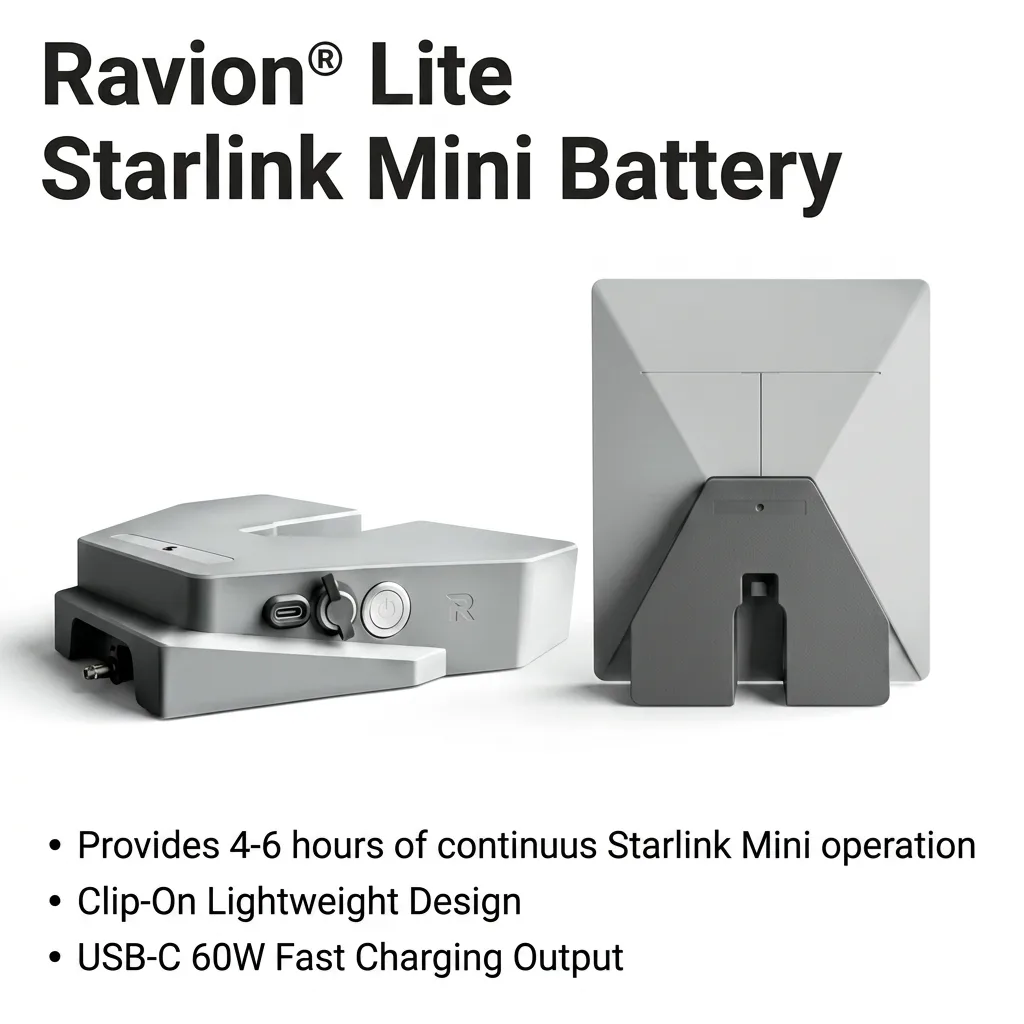
Ravion® Battery Lite
99Wh · up to 6 h runtime · 1.9 lbs · USB-C 60W out
$189 Shop now →
Free U.S. shipping · 30-day returns · 12-month warranty · Ships from California in 1 business day · See all power kits
Real-world numbers are often even kinder. After a firmware update in early 2026, many users report steady-state draw closer to 16–20 watts with a clear view of the sky, settling around 17W during normal browsing. Two caveats worth planning for:
- Startup surge: the dish can briefly spike to ~60W while it boots and acquires a satellite. Size your cabling and any DC adapter for the peak, not the average.
- Cold, obstructions, and heavy data all push consumption toward the top of the range. Streaming and video calls land around 30–35W.
One more spec that matters for batteries: Starlink recommends a USB-C Power Delivery source rated 100W (20V/5A) for optimal operation, and the Mini will not run on PD sources below 65W. It also accepts 12–48V DC through a barrel-jack cable — the route most off-grid users prefer because it skips inverter losses. (See Starlink's guide on how to power the Starlink Mini for the full list of supported sources.)
The Runtime Formula (It's Simpler Than You Think)
Battery capacity is measured in watt-hours (Wh). To estimate how long a battery powers your Mini:
Runtime (hours) ≈ Battery Wh × 0.9 ÷ Average Watts
The 0.9 accounts for real-world losses — voltage conversion, heat, and the battery's own electronics. Clip-on DC batteries lose a little less; power stations running through an AC inverter lose a little more. As an example, a 158Wh battery at a typical 25W load works out to roughly 158 × 0.9 ÷ 25 ≈ 5.7 hours, climbing toward 8–9 hours when the dish is mostly idle. Always size with headroom so you're not draining to zero every day.
Starlink Mini Battery Runtime Chart
Here's how common capacities translate to hours at three realistic loads — light browsing, typical mixed use, and heavy streaming or video calls:
| Battery Capacity | Light (~17W) | Typical (~25W) | Heavy (~38W) |
|---|---|---|---|
| 99 Wh Lite / Power Bank | ~5 h | ~3.5 h | ~2.3 h |
| 158 Wh Ravion | ~8.4 h | ~5.7 h | ~3.7 h |
| 245 Wh Power Station | ~13 h | ~8.8 h | ~5.8 h |
| 288 Wh Power Station | ~15 h | ~10.4 h | ~6.8 h |
Estimates assume ~90% real-world efficiency. Idle-only runtime (15W) runs slightly longer than the "light" column. Your mileage varies with temperature, obstructions, and data use.

Best Batteries for the Starlink Mini in 2026 — Compared
There are two families to choose from. Clip-on batteries snap directly to the Mini for true grab-and-go portability. Portable power stations hold more energy and power other gear too, but they're bulkier and tether the dish to a cable. Here's how the leading options stack up:
| Battery | Type | Capacity | Est. Mini Runtime | Weight | Price* |
|---|---|---|---|---|---|
| Ravion® Battery | Clip-on | 158 Wh | 6–9 h | 2.6 lb | $328 |
| Ravion® Battery Lite | Clip-on | 99 Wh | 4–6 h | 1.9 lb | $189 |
| PeakDo LinkPower 1 | Clip-on bank | 99 Wh | 4–6 h | ~2.0 lb | $159 |
| EcoFlow River 3 | Power station | 245 Wh | 8–13 h | ~7.7 lb | ~$200 |
| Anker SOLIX C300 | Power station | 288 Wh | 10–15 h | ~8.4 lb | ~$250 |
| Bluetti Elite 30 V2 | Power station | 288 Wh | 10–15 h | ~8.6 lb | ~$230 |
| Jackery Explorer 300 | Power station | 293 Wh | 10–15 h | ~7.1 lb | ~$200 |
*Prices for third-party power stations are approximate and fluctuate frequently; check the retailer. Ravion and PeakDo prices are current Satellite Link Power listings.
Battery Reviews
Ravion® Battery for Starlink Mini — 158Wh
$328The flagship is purpose-built for the Mini: it slides on tool-free, seals to IP65 against rain and dust, and supports pass-through charging so the dish stays online while the pack recharges. At 158Wh it sits just under the 160Wh FAA carry-on limit, so it flies with you. For most people this is the sweet spot — a genuine full workday of connectivity in a package you can mount on a roof, a pole, or a tripod.
Ravion® Battery Lite — 99Wh
$189The Lite trims weight to 1.9 lb while keeping the same clip-on, weatherproof design. The standout extra is a 60W USB-C output that tops up your phone, tablet, or laptop between sessions. Four-to-six hours covers a day hike, a beach afternoon, or a weekend campsite where you're online in bursts rather than all day.
PeakDo LinkPower 1 Power Bank — 99Wh
$159The most affordable way to cut the cord. The LinkPower 1 is a 27,500mAh snap-on bank with USB-C Power Delivery, an LCD readout, and app-based battery monitoring so you can watch your remaining charge in real time. Runtime matches the 99Wh Lite, and it doubles as a general-purpose power bank for the rest of your kit.
Portable Power Stations (EcoFlow · Anker · Bluetti · Jackery)
~$200+If you need to run a laptop, lights, or a fridge alongside the dish, a 250–300Wh power station earns its place. The EcoFlow River 3, Anker SOLIX C300, Bluetti Elite 30 V2, and Jackery Explorer 300 all deliver 8–15 hours of Mini runtime. Power the dish through their USB-C PD port rather than the AC inverter to minimize losses. The trade-offs: they're bulkier, they tether the Mini to a cable, and none clip onto the dish or carry an IP weather rating. Note the older Jackery 300 uses lithium-ion rather than LiFePO4, so it recharges slower and ages faster than the others.
Clip-On Battery vs. Power Station — Which Should You Choose?
- Choose a clip-on battery if portability, weatherproofing, mounting, or air travel matter. It moves with the dish, survives rain and dust, and stays under the FAA limit. This is the right answer for most Mini owners.
- Choose a power station if you're powering several devices from a fixed spot and don't mind the bulk, the cable, and the lack of weather sealing.
- Run both for serious deployments: a power station at camp plus a clip-on battery for when you reposition the dish or head out for the day.
How to Stretch Your Starlink Mini Runtime
- Add solar. Both Ravion batteries accept solar input, which can keep you online indefinitely on a sunny day.
- Use pass-through charging. Recharge the battery from a vehicle or solar source while the Mini keeps running — zero downtime.
- Power from your vehicle. The Ravion 12–24V DC Power Adapter runs the setup straight off any RV, boat, or overland 12V/24V system.
- Mount for a clear sky. A clean, unobstructed view means the dish works less and draws less. The Magnetic Mount, Suction Cup Mount, and 1/4"-20 Tripod Bracket get it positioned in seconds.
- Idle smart. Putting the dish to sleep when you're not online drops draw to ~15W and buys hours.
Frequently Asked Questions
How many watts does the Starlink Mini use?
How long will a 99Wh battery run the Starlink Mini?
How long does the 158Wh Ravion battery last?
Can I fly with a Starlink Mini battery?
Can I power the Starlink Mini directly from a power bank?
How do I keep the Starlink Mini powered indefinitely?
Is a clip-on battery or a power station better for the Starlink Mini?
Match the Right Battery to Your Mission
From ultralight day-trip power to all-day field uptime — every Ravion battery clips on tool-free, seals to IP65, and ships in one business day.
Shop Starlink Mini Power → View All ProductsSources: Starlink official power specifications and Starlink Mini power-source guidance (starlink.com). Runtime figures are estimates based on rated capacity at ~90% real-world efficiency and will vary with temperature, obstructions, signal conditions, and data use.