Starlink Mini for Camping: The No-Generator Internet Setup
Reliable internet at any campsite — without the noise, fuel, or weight of a generator. Here's the math, the gear, and the exact setup that keeps you online for days.
A generator can keep your Starlink Mini online at camp — but it's the single piece of gear most campers wish they could leave at home. It's loud, it's heavy, it burns fuel you have to carry, and a growing list of campgrounds restrict or ban it outright during quiet hours.
The good news: with the Starlink Mini, you almost certainly don't need one. The Mini is the most power-efficient dish SpaceX makes, and a January 2026 firmware update cut its real-world draw by roughly 25% — to around 17 watts in typical use. At that level, a clip-on battery the size of a paperback can do everything a generator does for satellite internet, silently. This guide walks through why that works, how to size your setup, and the exact gear that turns "internet at camp" into a 90-second, tool-free routine.
Why skip the generator entirely?
It comes down to four things campers consistently regret about running a generator just to stay connected:
Ravion® · Built only for Starlink Mini
Run your Mini up to 9 hours, no outlet.
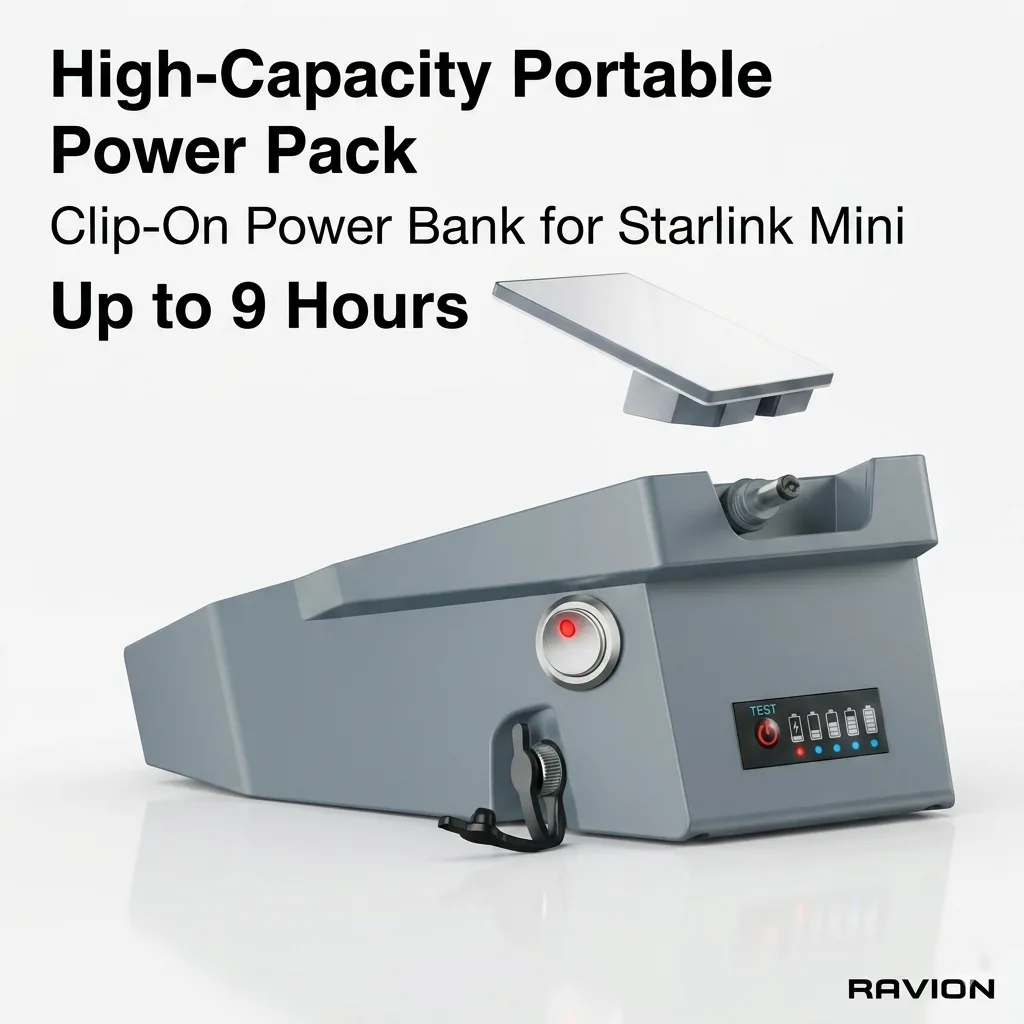
Ravion® Battery
158Wh · up to 9 h runtime · IP65 · 2.6 lbs · Under FAA 160Wh limit
$328 Shop now →
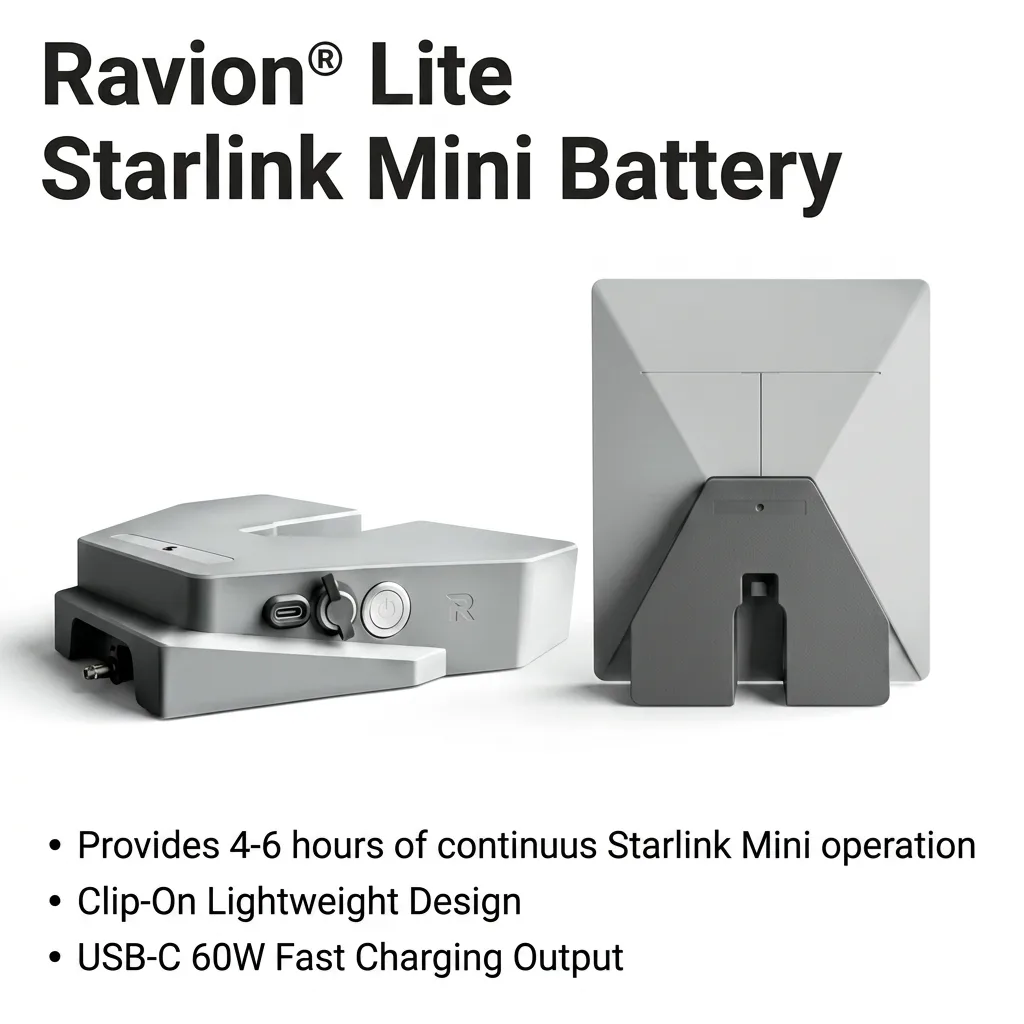
Ravion® Battery Lite
99Wh · up to 6 h runtime · 1.9 lbs · USB-C 60W out
$189 Shop now →
Free U.S. shipping · 30-day returns · 12-month warranty · Ships from California in 1 business day · See all power kits
Noise. A generator running all evening is the fastest way to ruin a quiet campsite — yours and your neighbors'. Many parks enforce quiet hours that make generator-powered internet impractical after dark, exactly when you might want it most.
Fuel and weight. Even a small inverter generator means carrying gas, oil, and 30–50 lbs of hardware for a device that sips power. It's wildly oversized for the job.
Efficiency. Generators (and AC inverters generally) waste energy converting power the Mini doesn't need converted. Running the dish on direct DC skips that loss entirely — often 15–20% more runtime from the same stored energy.
That's all a Starlink Mini needs for a full day of camp use (≈20W average × 24 hours). For perspective, that's roughly what a single LED bulb uses in a day — and a fraction of what a standard Starlink dish demands.
The math: how much battery do you actually need?
Battery runtime is simple to estimate. Take the battery's capacity in watt-hours, divide by the Mini's average draw (use 20W as a conservative number), and multiply by about 0.85 for real-world losses:
So a 158Wh battery delivers roughly 6–9 hours depending on how hard the dish is working, and a 99Wh battery lands around 4–6 hours. Light use (email, messaging, a clear sky view) pushes you toward the top of each range; 4K streaming, video calls, cold weather, or an obstructed view pull it down.
For most campers that means one battery covers an evening of work and streaming, and a second battery — or solar to top up during the day — covers a multi-day trip without ever touching a wall outlet.
Your no-generator camp setup, step by step
1 · Clip on a battery
Start with power. The Ravion® Battery (158Wh) slides directly onto the Starlink Mini with no cables or brackets — tool-free in seconds — and supports pass-through charging so you can run and recharge at the same time. Traveling light? The Ravion® Battery Lite (99Wh) drops the weight to 1.9 lbs and adds a 60W USB-C output for your phone and laptop.
2 · Mount it for a clear sky view
Signal quality is the biggest driver of both speed and power draw, so placement matters. A Ravion® Magnetic Battery Mount grips a vehicle roof or any steel surface with up to 240 lbs of holding force at an optimized 20°–30° angle, while the 1/4"-20 tripod bracket lets you set the dish on any camera tripod for an unobstructed line to the sky.
3 · Plan your recharge
For multi-day trips, recharge from the sun or your rig. Both Ravion batteries accept solar input, and the Ravion 12–24V DC Power Adapter tops up the battery directly from any vehicle, RV, or boat DC system — no generator, no AC outlet.
4 · Pack it to survive the trip
Protect the kit between campsites with the Ravion® Battery Travel Case — an EVA hard shell with YKK waterproof zippers and purpose-built compartments for the dish, battery, and cables, in one- or two-battery configurations.
Choosing your battery
Three snap-on options cover everything from a single overnight to a working week off-grid. All clip directly to the Starlink Mini.
Ravion® Battery
The all-rounder. Enough capacity for a full work-and-stream evening, with pass-through charging and FAA carry-on compliance. The one most campers should start with.
Ravion® Battery Lite
Built for backpackers and weekend trips. Under 100Wh for no-hassle air travel, and a 60W USB-C port that charges your devices too.
PeakDo LinkPower 1
A capable snap-on power bank with a live LCD readout and smart app monitoring — a wallet-friendly entry point for day trips and casual use.
Quick rule of thumb: one night out → the Lite or PeakDo; a full work-from-camp evening → the 158Wh Ravion®; a multi-day trip → a 158Wh battery plus solar, or two batteries you rotate.
Staying online for days, not hours
The trick to genuinely unlimited off-grid runtime isn't a bigger battery — it's a recharge loop. Pair a Ravion battery with a portable solar panel and the dish effectively runs on sunlight, with the battery buffering through clouds and overnight. On the road between sites, the 12–24V DC adapter recharges straight from your vehicle. Between the two, most campers never plug into shore power at all.
A few field-tested habits
Chase a clear sky. An unobstructed view isn't just about speed — obstructions force the dish to work harder and draw more power. A few feet of repositioning can add real runtime.
Use the sleep schedule. Set the Starlink app to power down overnight or during hours you don't need connectivity. It's the easiest way to stretch a single charge across a whole trip.
Go DC, not AC. Whenever you can, power and recharge over direct DC rather than through an inverter. It's the single biggest efficiency gain available to you.
Mind the cold. Below freezing, the dish draws more to keep itself warm and battery capacity dips. On cold-weather trips, size up to the 158Wh battery and keep spares insulated.
Frequently asked questions
Do I really not need a generator for Starlink Mini at camp?
For the Mini, correct — a generator is overkill. The dish averages around 17–20 watts, so a clip-on battery like the Ravion® 158Wh covers a full evening silently, and solar or a DC recharge keeps you going for days. Generators only start to make sense if you're powering large, high-draw appliances alongside your internet.
How long will a battery run the Starlink Mini on one charge?
Roughly 6–9 hours on the 158Wh Ravion® and about 4–6 hours on a 99Wh battery, depending on usage. Light browsing with a clear sky view lands at the top of each range; heavy streaming, video calls, cold weather, or obstructions pull it lower.
Can I fly with these batteries?
Yes. The 99Wh Lite sits under the 100Wh threshold, so it carries on with no airline approval needed. The 158Wh Ravion® falls under the 160Wh FAA carry-on limit, which airlines permit with approval (typically up to two spare batteries). Always pack lithium batteries in your carry-on, never checked luggage, and confirm your carrier's current policy before you fly.
Will my setup survive rain at camp?
The Ravion batteries are rated IP65 — fully dustproof and built to handle sustained water jets, rain, and salt spray. For transport and storage between sites, the hard-shell travel case adds shock and weather protection.
Can I recharge from my car, van, or RV?
Yes. The Ravion 12–24V DC Power Adapter tops up your battery directly from any 12V or 24V vehicle or mobile DC system — RVs, boats, and overland rigs included — with no inverter and no wall outlet.
Can I add solar for unlimited runtime?
Both Ravion batteries accept solar input. Pairing a panel with the battery creates a recharge loop that can keep the Mini online indefinitely off-grid, with the battery covering cloudy stretches and overnight use. Browse compatible options in Starlink Mini Power Kits.
Which battery should I buy for a weekend versus a week?
For a single overnight, the Lite or the PeakDo LinkPower 1 is plenty. For a full work-from-camp evening, choose the 158Wh Ravion®. For a week off-grid, pair the 158Wh with solar or carry two batteries and rotate them.
Does cold weather reduce runtime?
It can. Below freezing, the dish uses extra power to stay warm and lithium batteries temporarily lose some usable capacity. On cold trips, plan for shorter runtimes, size up to the 158Wh battery, and keep spares insulated and close to body temperature when possible.
Is it actually silent?
Completely. A battery-powered Starlink Mini has zero moving parts and makes no noise — a genuine advantage over a generator at a quiet campsite, and the reason it's allowed where generators aren't.
Leave the Generator Home.
Everything you need to run Starlink Mini off-grid — batteries, mounts, DC adapters, and travel cases. Free U.S. shipping, ships in one business day.
Runtime figures are estimates based on real-world field data and a conservative 20W average draw; actual results vary with temperature, sky obstructions, data load, and battery age. Always follow your airline's current lithium-battery policy. Ravion® is a registered trademark. Starlink® is a trademark of SpaceX; Satellite Link Power is not affiliated with or endorsed by SpaceX.