Ravion vs PeakDo LinkPower 1: Which Starlink Mini Battery Should You Buy?
Three clip-on batteries, three price points. Here is an honest Ravion vs PeakDo comparison with the runtime math, the specs each brand actually publishes, and who should buy which.
We sell all three packs at Satellite Link Power, so this is not a hit piece on any of them. Where a brand does not publish a spec, we say so instead of guessing.
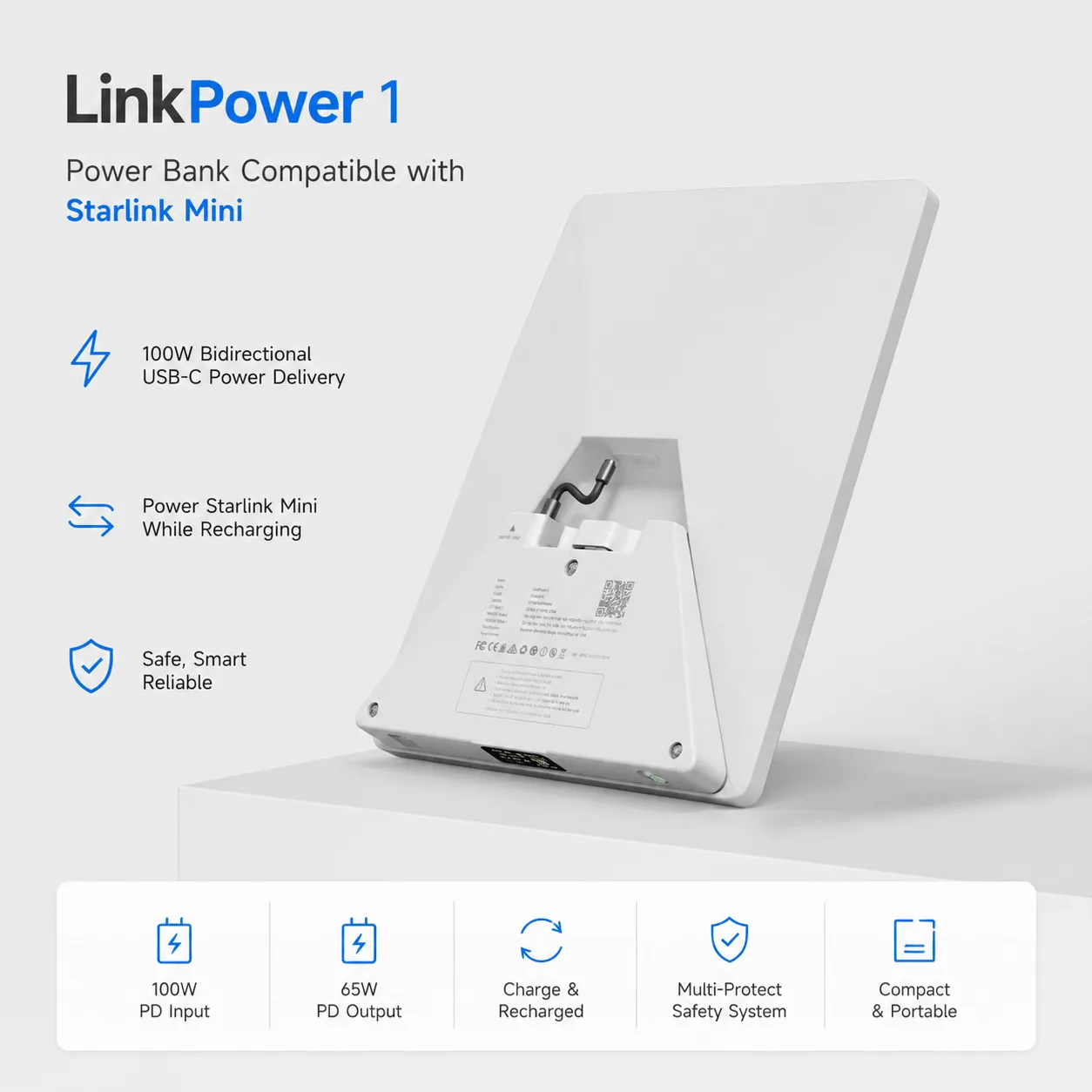
Ravion vs PeakDo comes down to hours versus weight. The PeakDo LinkPower 1 ($159, 99Wh, 1.42 lbs) is the cheapest and lightest pack, with an LCD, an app and 100W USB-C charging. The Ravion Battery ($329, 158Wh, 2.6 lbs) holds 60% more energy, carries a published IP65 rating and plugs straight into our 74W solar panel.
- Weekend use, flies often: PeakDo LinkPower 1.
- Full workday, boats, rain, solar: Ravion Battery 158Wh.
- Flies often but wants IP65: Ravion Battery Lite ($189, 99Wh).
Most people comparing Ravion vs PeakDo want one answer: which battery keeps a Starlink Mini online for the way they actually use it? The short version is that the PeakDo LinkPower 1 is the light, cheap, gadget-friendly pack, and the Ravion Battery is the long-runtime, weather-rated one. The Ravion Battery Lite sits in between. The details below are taken from each product’s published specs, and where a spec is not published we mark it that way.
Ravion® · Built only for Starlink Mini · New Mini owner? Start here
Run your Mini up to 9 hours, no outlet.
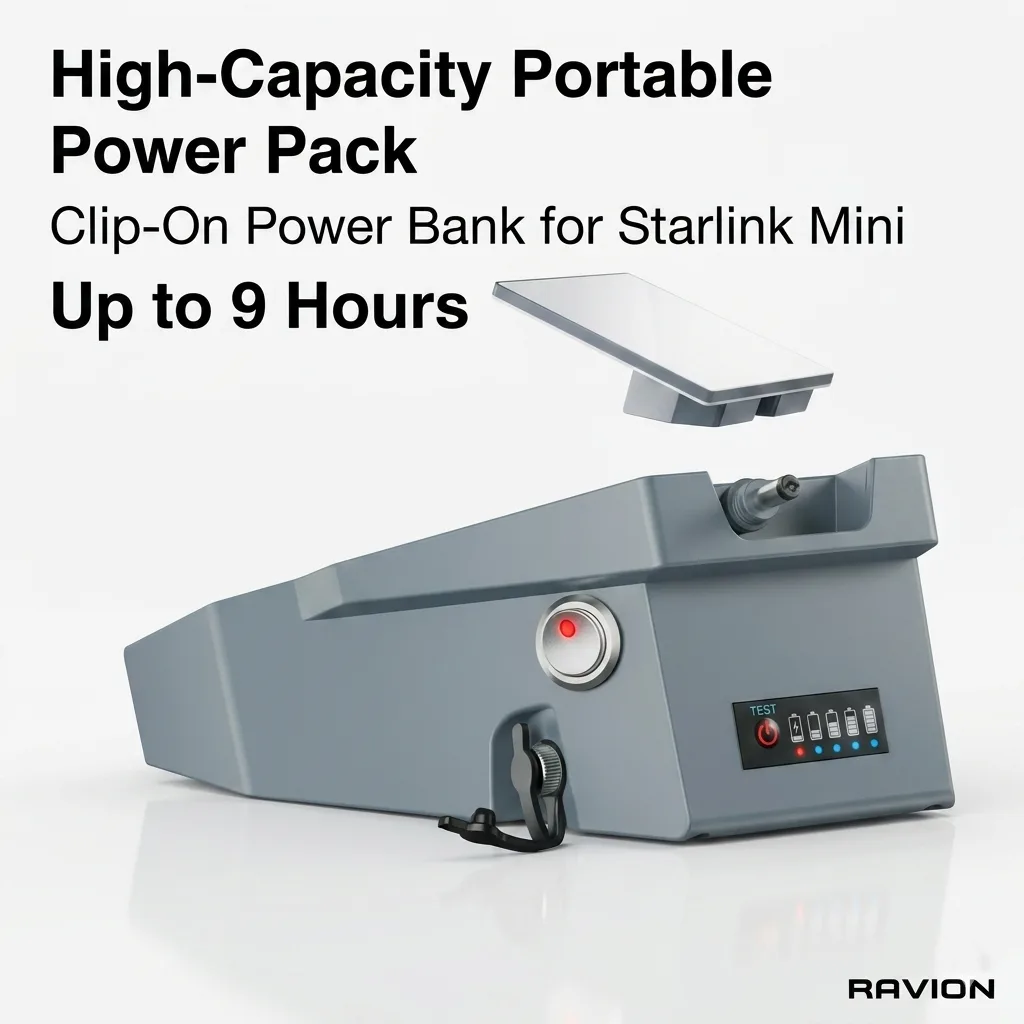
Ravion® Battery
158Wh · up to 9 h runtime · IP65 · 2.6 lbs · Carry-on w/ airline approval
$329 Shop now →
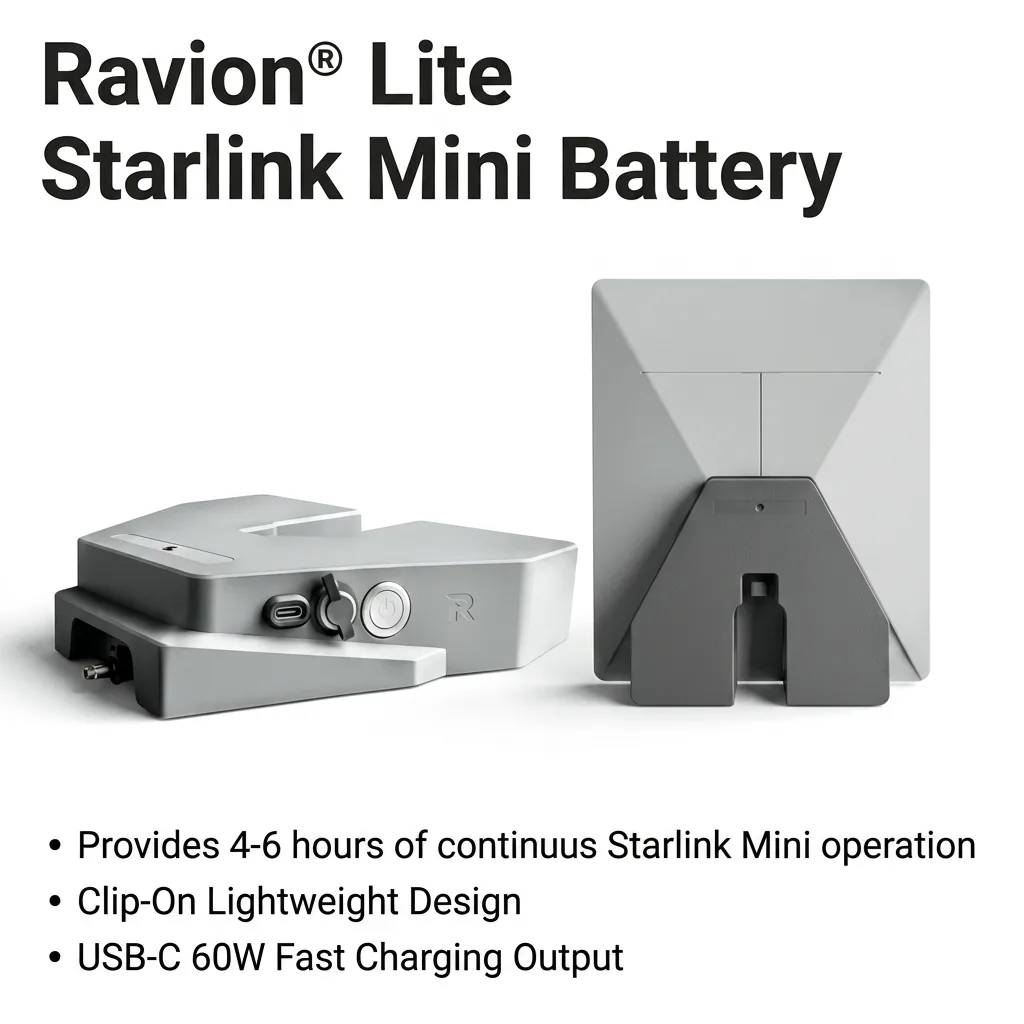
Ravion® Battery Lite
99Wh · up to 6 h runtime · 1.9 lbs · USB-C 60W out
$189 Shop now →
Free U.S. shipping on orders $100+ (West Coast) / $200+ (other states) · 30-day returns · 12-month warranty · Ships from California in 1 business day · See all power kits
Ravion vs PeakDo: side-by-side specs
| Spec | Ravion Battery (158Wh) | Ravion Battery Lite | PeakDo LinkPower 1 |
|---|---|---|---|
| Price | $329 | $189 | $159 |
| Capacity | 158Wh | 99Wh | 99Wh (27,500mAh) |
| Rated runtime | 6–9 h | 4–6 h | 4+ h |
| At a steady 30W (our math) | ~4.5 h | ~2.8 h | ~2.8 h |
| Weight | 2.6 lbs | 1.9 lbs | 1.42 lbs |
| Attaches | Tool-free clip-on | Tool-free clip-on | Snap-on buckle |
| Water / dust rating | IP65 | IP65 | Not published |
| USB-C output | Not listed | 60W | 65W |
| Recharges from | Wall charger, DC adapter, 74W solar panel | Original Starlink charger, USB-C | USB-C PD, up to 100W in |
| Display / app | Not listed | Not listed | LCD + app |
| Tripod mounting | With ¼″-20 bracket ($28) | With ¼″-20 bracket ($28) | 3 built-in ¼″ holes |
| Flies carry-on | With airline approval | No approval needed | No approval needed |
| Safety certification | UN38.3 listed | Built-in protections | Not listed |
| Price per Wh | $2.08 | $1.91 | $1.61 |
Both Ravion packs cover the Mini’s RJ45 Ethernet port while attached; Wi-Fi is unaffected. PeakDo does not say either way for the LinkPower 1.
Real runtime: the math behind the numbers
Battery makers quote runtimes for light use. A Starlink Mini averages roughly 25–40W according to Starlink’s published specifications, and it draws more in cold weather or with heavy uploads. To get a realistic number, take the capacity, allow about 15% for conversion losses, and divide by the draw: Wh × 0.85 ÷ watts = hours.
| Average draw | Ravion Battery (158Wh) | 99Wh packs (Lite or PeakDo) |
|---|---|---|
| 25W (light browsing) | ~5.4 h | ~3.4 h |
| 30W (typical) | ~4.5 h | ~2.8 h |
| 40W (heavy use, cold) | ~3.4 h | ~2.1 h |
The Ravion Lite and the PeakDo LinkPower 1 hold the same 99Wh, so expect the same runtime from either one at the same draw. For a deeper look, see how long the Starlink Mini runs on battery.
Where the PeakDo LinkPower 1 wins
- Price and weight. At $159 it costs $170 less than the Ravion Battery, and at 1.42 lbs it is more than a pound lighter. If the dish lives in a backpack, that matters.
- Information. The LCD shows the charge level and the app lets you monitor it remotely.
- USB-C in and out. It accepts up to 100W over USB-C PD, so a good laptop charger can refill it, and it pushes up to 65W out to a phone or laptop. A physical switch turns the Mini’s DC output off while the USB-C port stays live.
- Built-in tripod holes. Three ¼″ threaded holes let it go straight onto a camera tripod.
- Flying. At 99Wh it goes in your carry-on with no airline paperwork under the FAA PackSafe lithium battery rules.
Where the Ravion Battery wins
- Hours. This is the main argument. 158Wh is 60% more energy than 99Wh: about 4.5 hours against 2.8 at a steady 30W. That is close to two extra hours online per charge.
- Weather. The Ravion Battery carries a published IP65 rating for rain, spray and dust. PeakDo does not publish a rating for the LinkPower 1, which is why we point boat owners and job-site crews to the Ravion. Our boat guide shows the setup.
- Solar. The Ravion 74W solar panel is built for this battery and refills it in roughly 5–7 hours of strong sun, with pass-through so the Mini keeps running.
- Paperwork. UN38.3 certification is listed on the spec sheet, which helps when a fleet manager or safety officer asks for it.
It sits in the FAA 101–160Wh band: carry-on only, never checked, airline approval required, and no more than two per passenger. If you fly every month, a 99Wh pack is simpler. Details in flying with a Starlink Mini battery.
The middle option: Ravion Battery Lite
The Ravion Battery Lite has the same 99Wh as the PeakDo, so runtime is the same and it also flies with no approval. For $30 more you get a published IP65 rating and a tool-free clip-on design, plus 60W USB-C output and compatibility with the original Starlink charger. You give up the PeakDo’s LCD, app and built-in tripod holes. Note that the 74W solar panel is designed for the 158Wh Ravion Battery only.
Ravion vs PeakDo: who should buy which
| If you are… | Buy | Why |
|---|---|---|
| A weekend camper or frequent flyer on a budget | PeakDo LinkPower 1 | Cheapest and lightest; no airline paperwork |
| Working a full day on the dish, RV or van life | Ravion Battery 158Wh | About 60% more runtime, solar-ready |
| On a boat, job site or anywhere wet | Ravion Battery 158Wh | Published IP65 rating plus the most hours |
| Flying often but out in the weather | Ravion Battery Lite | IP65 and under 100Wh |
| Running off-grid for days | Ravion Battery 158Wh + 74W panel | Recharge from the sun with pass-through |

Accessories and mounts
The 12–24V DC adapter runs the Mini from a car, truck, RV or boat and recharges a Ravion battery on the drive. The 60W charger takes the 158Wh battery to 80% in about 2.5 hours, and the hard travel case keeps the battery and cables together.
Ravion’s magnetic and suction cup mounts are designed around the Ravion packs. If you choose the PeakDo, its built-in ¼″ holes work with any standard tripod, including our tripod and stabilizer.


Ravion vs PeakDo FAQ
Which lasts longer, Ravion or PeakDo?
The 158Wh Ravion Battery. It stores 158Wh against 99Wh for the PeakDo LinkPower 1, about 60% more energy. At a steady 30W that works out to roughly 4.5 hours versus 2.8 hours; in lighter use the rated figures are 6–9 hours and over 4 hours.
Is the PeakDo LinkPower 1 waterproof?
PeakDo does not publish a water or dust rating for the LinkPower 1, so treat it as a dry-weather pack and keep it out of rain and spray. Both Ravion packs are rated IP65: dust-tight and protected against water jets, but not for submersion.
Which Starlink Mini battery can I take on a plane?
The PeakDo LinkPower 1 and the Ravion Battery Lite are both 99Wh, under the FAA 100Wh limit, so they fly carry-on with no airline approval. The 158Wh Ravion Battery is in the 101–160Wh band: carry-on only, with airline approval, and no more than two per passenger. None of them can go in checked bags.
Can I charge the battery and run the Starlink Mini at the same time?
Yes. All three packs support pass-through charging, so the Mini keeps running while the battery refills from a wall charger, a vehicle adapter or, on the 158Wh Ravion Battery, the 74W solar panel.
Do Ravion mounts fit the PeakDo LinkPower 1?
Ravion mounts are designed around the Ravion packs, and we do not list them as PeakDo-compatible. The LinkPower 1 has three built-in ¼″ threaded holes instead, so it goes straight onto any standard camera tripod.
Which is the better value per watt-hour?
The PeakDo LinkPower 1 at about $1.61 per Wh, then the Ravion Battery Lite at about $1.91 and the Ravion Battery at about $2.08. The Ravion premium pays for the IP65 rating, the extra capacity and, on the 158Wh pack, solar-panel support.
Get 15% off your first Starlink Mini power kit (up to $30)
Runtime tests, mount tips and new-gear alerts from our California workshop — one email a week, no spam. Your WELCOME15 code (15% off, up to $30) lands in your inbox right away.
Pick your Starlink Mini battery.
Free U.S. shipping on orders $100+ (West Coast) / $200+ (other states), same-day processing from South Gate, CA, 30-day returns and a 12-month warranty on every pack.