
Starlink Mini in Cold Weather and Snow: 7 Rules for Winter Battery Life
Starlink Mini cold weather performance surprises people: the dish is rated down to -22°F and melts its own snow. The battery feeding it is a different story. Here is what really changes below freezing, and how to keep your Mini online all winter.
Heading out this winter? Our 158Wh Ravion Battery and travel case are built for cold-weather trips. Keep reading for how to use them below freezing.
For Starlink Mini cold weather use, the dish itself is rarely the problem. The battery is. The Mini is rated to operate from -22°F to 122°F (-30°C to 50°C) and can melt up to 1 inch of snow per hour. Lithium batteries lose usable capacity in the cold, and the Ravion 158Wh battery is rated to operate from 14°F (-10°C) up.
- Keep the battery warm until you need it, and charge it above freezing.
- Plan for shorter runtime: budget roughly 20–30% less in freezing weather, our rule of thumb.
- Below 14°F: run from a warm battery or vehicle power, not a cold-soaked pack.
Winter is when a lot of Starlink Mini owners find out what their setup can really do. Ski trips, ice fishing, hunting camps and northern RV parks all mean freezing nights. The good news is that the dish is tough. The bad news is that most Starlink Mini cold weather problems come from the battery feeding it, and almost every guide skips that part.
Ravion® · Built only for Starlink Mini · New Mini owner? Start here
Run your Mini up to 9 hours, no outlet.
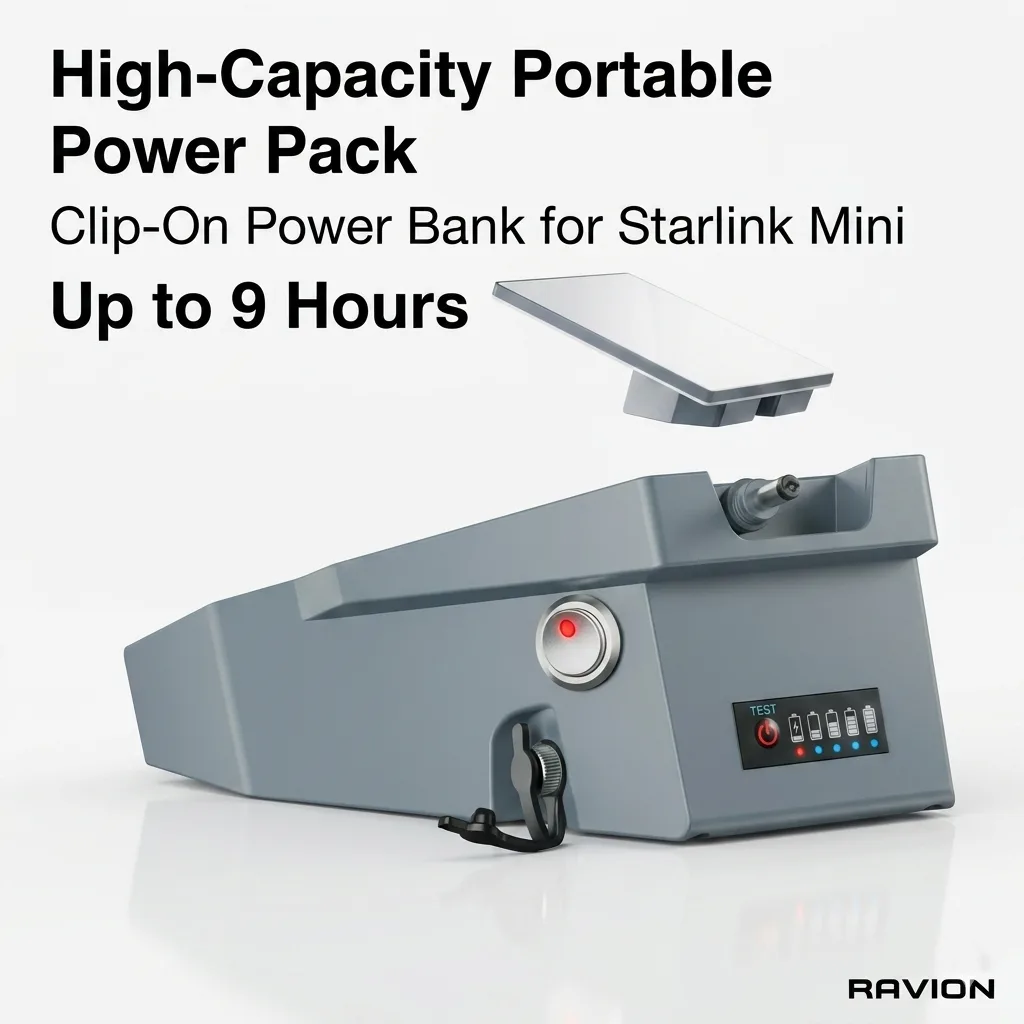
Ravion® Battery
158Wh · up to 9 h runtime · IP65 · 2.6 lbs · Carry-on w/ airline approval
$329 Shop now →
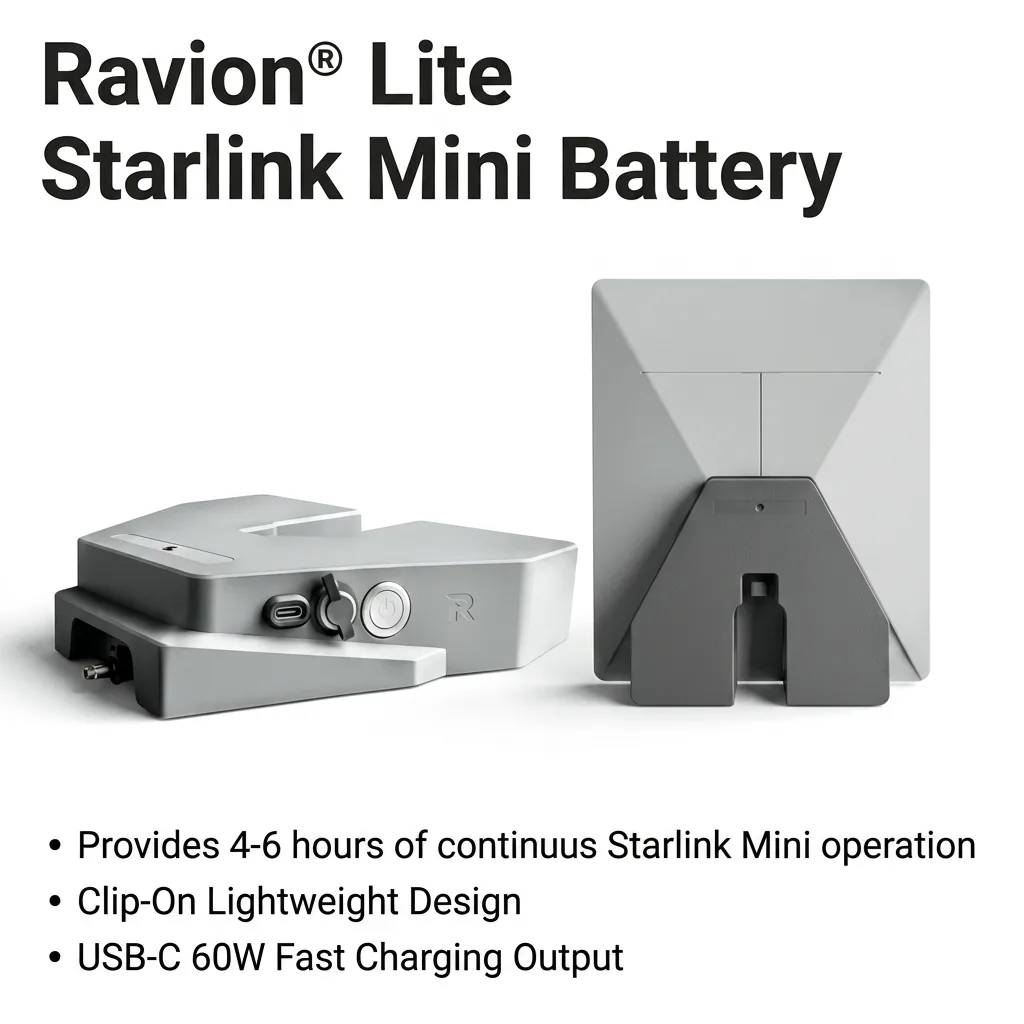
Ravion® Battery Lite
99Wh · up to 6 h runtime · 1.9 lbs · USB-C 60W out
$189 Shop now →
Free U.S. shipping on orders $100+ (West Coast) / $200+ (other states) · 30-day returns · 12-month warranty · Ships from California in 1 business day · See all power kits
What the Starlink Mini can handle in the cold
Starlink rates the Mini to operate from -22°F to 122°F (-30°C to 50°C), and it can melt up to about 1 inch (25 mm) of snow per hour (published specs). The antenna is sealed to IP67 with its cable installed. In other words, the dish will usually outlast your patience on a cold night.
The weak link is the battery. Ravion's spec sheet rates the 158Wh Ravion Battery to operate from 14°F to 113°F (-10°C to 45°C). That is a common range for lithium packs, and it is a narrower range than the dish.
| Air temperature | Starlink Mini | Clip-on battery | What to do |
|---|---|---|---|
| Above 50°F (10°C) | Normal | Normal | Nothing special. |
| 32–50°F (0–10°C) | Normal | Slightly shorter runtime | Keep the spare battery in a pocket or the cab. |
| 14–32°F (-10–0°C) | Normal, may melt snow | Noticeably shorter runtime; do not charge | Start with a warm battery. Charge only indoors or in the cab. |
| -22–14°F (-30– -10°C) | Within rating | Below the 158Wh rated range | Run from vehicle power or a battery kept warm until use. |
| Below -22°F (-30°C) | Outside rating | Outside rating | Pack it away until it warms up. |
Why batteries fade in the cold
A lithium battery stores energy in chemistry, and chemistry slows down when it is cold. A cold pack can still hold its charge, but it cannot deliver all of it quickly. When the Mini pulls 30–40W, a cold-soaked battery hits its voltage limits sooner and shuts off early, even though energy is technically left inside.
That is why the same battery can run your Mini for over four hours in October and noticeably less on a January night. Warm the pack back up and most of that capacity comes back. Cold does not usually destroy a battery. Charging it while frozen can.
Most lithium-ion manufacturers advise against charging below 32°F (0°C), because it can damage the cells permanently. Bring the battery into the cab, tent or cabin and let it warm up before you plug it in.
Snow melt and power draw
The Mini clears snow by warming itself, and that warmth comes from your battery. During a snowfall expect power draw to sit at the top of its 25–40W range or above, which shortens runtime further. Starlink does not publish a separate snow melt wattage for the Mini, so plan with margin rather than a fixed number.
If the snow is heavy and you are on battery, it is often better to brush the dish off by hand and save the power for the internet. Tilting the dish so snow slides off also helps.

7 Starlink Mini cold weather rules
- Keep the battery warm until you need it. Store it in the cab, a sleeping bag or an inside jacket pocket overnight, then clip it on right before use.
- Charge only above freezing. Use the vehicle cab with the 12–24V DC adapter, a warm cabin, or the 60W charger indoors.
- Budget 20–30% less runtime. Plan for about 3–3.5 hours from the 158Wh battery at a steady 30W instead of 4.5, more if it is bitterly cold.
- Use vehicle power below 14°F. When it is colder than the battery's rated range, run the Mini from the vehicle while the engine is on.
- Carry it in a hard case. Our hard travel case keeps the battery, cables and Mini together, and adds a layer between the pack and frozen ground.
- Store at partial charge between trips. Keep the battery somewhere warm and dry, around half charged, and top it up the night before you leave.
- Expect shorter solar days. Low winter sun means less charging. Our Starlink Mini solar panel guide shows how to angle the panel and what to expect.


Mounting the Starlink Mini in cold weather, snow and ice
Suction cup mounts
Suction cups grip best on clean, room-temperature glass. On a frosty window, run the defroster for a few minutes, wipe the glass dry and press each cup firmly. Check the mount before you drive and again after a big temperature drop. Our suction cup mount includes two spare cups for this reason.
Magnetic mounts
Magnets do not care about the cold, but they do need clean metal. Brush snow off and clear any ice from the contact area so all four magnets sit flat on the steel roof. The magnetic mount holds up to 240 lbs on bare steel and tilts 20°–30°, which also helps snow slide off.
Tripods and campsites
On snow, spread the legs wide and press them down into packed snow rather than fresh powder. Keep the battery off the ground if you can. A tripod with the ¼″-20 thread bracket keeps the whole setup above the snowpack.
If your Mini keeps restarting in the cold, the battery is the first suspect. Our reboot troubleshooting guide walks through the fixes.
Starlink Mini cold weather FAQ
How cold can a Starlink Mini operate?
The Starlink Mini is rated to operate from -22°F to 122°F (-30°C to 50°C), and its power supply has the same range. Below -22°F it is outside its published rating.
Does the Starlink Mini melt snow?
Yes. The Starlink Mini can melt up to about 1 inch (25 mm) of snow per hour. Melting snow uses extra power, so battery runtime is shorter during snowfall.
How much battery life do you lose in the cold?
It depends on how cold the battery itself gets. As a planning rule of thumb, budget roughly 20–30% less runtime in freezing weather, and more if the pack sits outside overnight. Keeping the battery warm until you use it recovers most of that loss.
Can I charge my Starlink Mini battery below freezing?
No. Most lithium-ion manufacturers advise against charging below 32°F (0°C), because it can damage the cells. Warm the battery in a vehicle cab, tent or cabin before charging it.
Do suction cup mounts work in cold weather?
They work, but cold, frosty glass grips less well. Clean and warm the glass with the defroster first, press the cups on firmly and check them before you drive. On steel roofs, a magnetic mount is unaffected by the cold once the contact area is clear of ice.
Get 15% off your first Starlink Mini power kit (up to $30)
Runtime tests, mount tips and new-gear alerts from our California workshop — one email a week, no spam. Your WELCOME15 code (15% off, up to $30) lands in your inbox right away.
Winter-proof your Starlink Mini power.
IP65 clip-on batteries, a hard travel case and 12–24V vehicle charging. Free U.S. shipping on orders $100+ (West Coast) / $200+ (other states), 30-day returns, 12-month warranty.