Starlink Mini power consumption averages 25–40W, about 20W at idle, and up to roughly 60W for short bursts when the dish is cold-starting or melting snow. Those three numbers decide everything downstream: which USB-C source will hold it, how many hours a given battery lasts, and whether you can leave it on overnight in an RV. Here is what the dish actually pulls in each state, measured with an inline USB-C power meter, and how to turn that into a battery or solar plan that doesn't strand you.
Starlink Mini power consumption by state
State
Typical draw
What's happening
Boot / acquiring satellites
35–45W for 1–3 min
Motors, radios and search all at once
Idle, connected, no traffic
18–24W
Keeping the link alive
Browsing, email, messaging
22–28W
Light radio duty
Video call / HD streaming
28–36W
Sustained up + down traffic
Large uploads
32–40W
Transmit side works hardest
Snow-melt heater on
50–60W bursts
Only below freezing with precipitation; can be disabled in the app
Two practical takeaways about Starlink Mini power consumption. First, the "25–40W" figure Starlink publishes on its spec sheet is honest: a normal work day averages right around 30W. Second, the bursts are what kill undersized power sources — a 45W laptop brick will run the Mini at idle and then reboot it the first time the heater or a big upload spikes. That's the single most common cause of the "my Mini keeps rebooting" complaint we walk through in 7 Starlink Mini power mistakes.
Turning watts into hours
Use usable hours = Wh × 0.85 ÷ average watts. The 0.85 accounts for conversion losses inside the battery and cable. For average watts, plug in your real Starlink Mini power consumption: 30W for a mixed workday, 24W for a quiet standby day, 35W if you're on video calls all day.
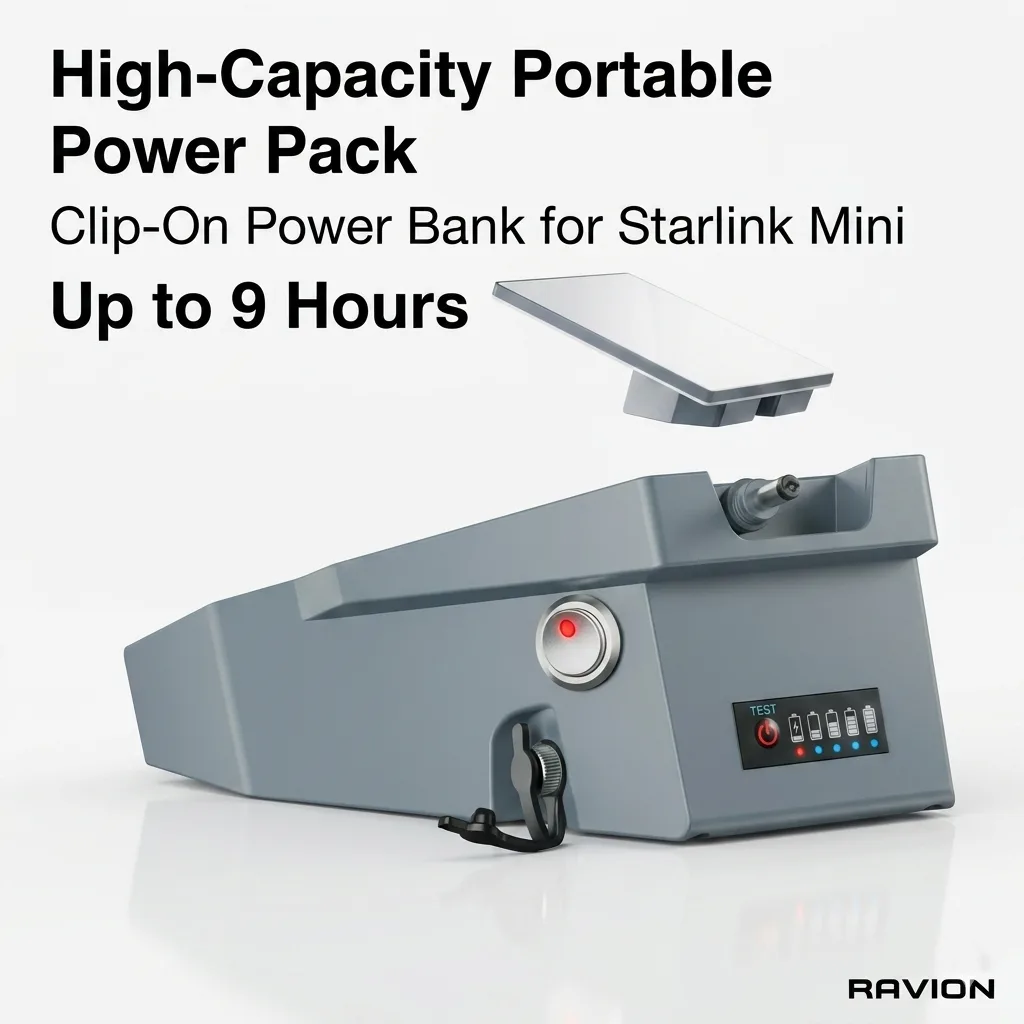
Real-world numbers land higher than the "mixed day" column because nobody streams for 100% of the session — the dish drops back to ~20W between calls, which is why the 158Wh Ravion® pack is rated 6–9 hours rather than 4.5. If you need the whole day untethered, battery vs. power station covers when the bigger box is worth carrying.
Starlink Mini power consumption 24/7 in an RV, van or boat
At 30W the Mini uses about 720Wh per day, or 60Ah from a 12V house battery. A 100Ah LiFePO4 bank runs it for about 1.5 days on its own; a 200W solar panel in decent sun covers the daily draw with margin. Feed it from the vehicle side through a purpose-built 12–24V DC adapter rather than a cigarette-lighter USB plug — most of those cap at 18–30W and cause the same reboot loop as an undersized brick. To cut Starlink Mini power consumption: disable snow-melt unless it's snowing, use the app's overnight sleep schedule, and keep the dish out of hot sun so the fan stays quiet.
Wall power: the stock Starlink adapter is fine; any 100W USB-C GaN charger works as a spare.
Vehicle: 12–24V DC adapter rated ≥60W, direct to a fused circuit or the house battery.
Solar: panel → charge controller → battery → Mini. Never panel-direct: the dish hates the voltage swings.
FAQ
How many watts does Starlink Mini use?
Starlink Mini power consumption is about 20W idle, 25–40W in normal use, with short bursts to 50–60W when the snow-melt heater runs or during boot.
How much power does Starlink Mini use per day?
Roughly 600–800Wh over 24 hours of continuous operation, or 50–65Ah from a 12V battery. Using the app's sleep schedule overnight cuts that by a third or more.
Can I run Starlink Mini on a 12V battery?
Yes, through a 12–24V DC-to-USB-C PD adapter rated for at least 60W. A 100Ah LiFePO4 battery gives about 1.5 days of continuous use.
Does Starlink Mini use more power in the cold?
Only when the snow-melt heater is active, which needs both freezing temperatures and precipitation. Cold air alone does not raise Starlink Mini power consumption; you can disable snow-melt in the Starlink app.
What size solar panel runs Starlink Mini?
A 200W panel into a battery covers a full day's draw in average sun; 100W works in strong sun with a battery buffer. Always go through a battery, not panel-direct.
Starlink Mini batteries from $189Ravion® 99Wh & 158Wh · up to 9 h · free U.S. shipping on orders over $100 (West Coast) or $200 (other states) · 30-day returns